
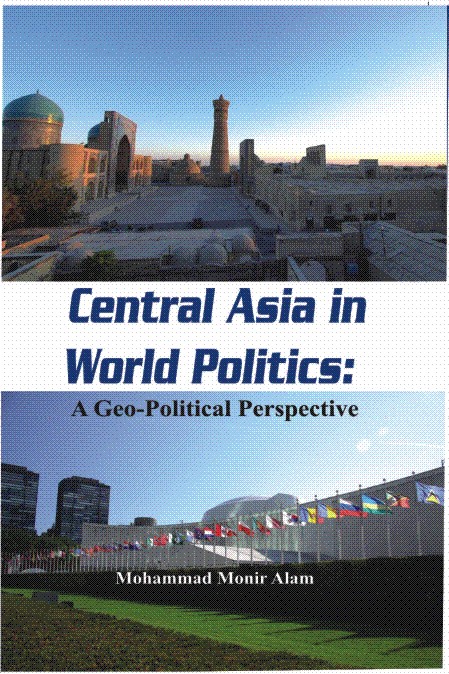
Central Asia has remained theatre of geo-political contest throughout the 19th as well as 20th century. The emergence of the Central Asian states on the vast Eurasian landmass has added a new strategic dimension to the Asian as well as world geopolitics. The Intensified geo-political and strategie context within three great powers United States, Russia and China has created a situation of instability. Moreover, the collapse of the Soviet Union not only altered the international geo-strategic balance but also largely created a security vacuum in the Central Asian region. As a result, the region has witnessed fierce international rivalry and competition to influence the newly independent states. The weakening of Russian influence started the new "Great Game". This new "Great Game" is about strategic influence and control over the energy resources of Central Asia. Despite India's historical linkages with the Central Asian states, India was slow in responding to the emerging strategic situation. However, India exercises greater influence in the region to ensure a regime of peace and stability. But, there is a need to evolve and pursue new strategic relations alongside issues of socio-economic transformation, political developments, security and stability. It is cooperation and constructive engagement that should be the cornerstone of India's approach towards Central Asia. Now it is time to translate India's common desire of potential economic cooperation into tangible action.
Dr. Mohammad Monir Alam is former Director, Department of Strategic and Regional Studies. University of Jammu, Jammu and Kashmir. India. After completing his Doctorate from School of International Studies, Jawaharlal Nehru University, New Delhi, he served as Fellow at Maulana Azad Institute of Asian Studies, Kolkata, India. After joining University of Jammu in 2002, he has been actively engaged in teaching and research. Besides co- editing two books on Central Asia: Present Challenges and Future Prospects; and Pakistan Occupied Kashmir: Internal Dynamics and Externalities; he has authored three books under title:- Russia and Tajikistan: Political and Security Relationship; Pakistan Occupied Kashmir: Constitutional Status and Political Reality; and Revival of the Silk Route: Growing Role of India; and one monograph as Brig. Rajinder Singh Paper on "Origin, Evolution and Development of Security Studies". He has credit of publication of many research papers in journals and books of national and international repute on diverse themes like Strategic and Security Studies, National Security, Homeland Security, Geo-politics of Central Asia, Iran, Afghanistan, Pakistan Occupied Kashmir and India's Energy Security. He is also the Editor of bi- annual international refereed journal Security and Society well as ACROSS LOC, a quarterly digestion developments in Pakistan Occupied Kushmir.
Acknowledgement
Foreword
Bibliography
Index

$280.00