
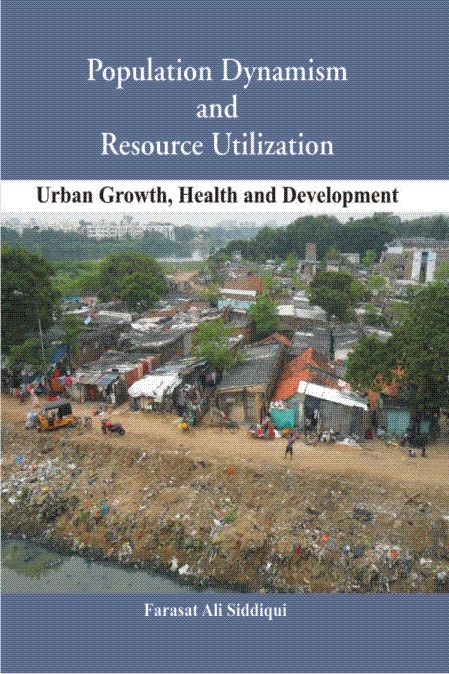
The scope of population dynamism and resource utilization in geography is so wide as to almost defy listing, let alone be captured in three volumes. The contributors attempt to give us a veritable kaleidoscope of studies in population and its nexus with resource utilization and development by applying a range of methodologies and techniques. This spectrum of topic, the tools and techniques is representative enough as to provide the reader with a sense of the richness and depth of these fields. The edited books entitled population dynamism and resource utilization, are trifurcated into volumes: one (population composition and development), two (urban growth, health and development), and three (geo informatics and resource dynamics). The volume one comprises twenty seven chapters which are arranged under three parts, namely, part one: population and resource (seven chapters), part two: education and occupation (twelve chapters), and part three: migration and fertility (eight chapters). The volume two includes twenty four chapters which are trifurcated into unequal parts. They are urbanisation and urban problems, health and diseases, and ruralurban linkages comprised respectively of ten, nine and five chapters. The volume three comprised of twenty six chapters is managed by the editor into three parts, namely, part one: agriculture resource (twelve chapters), part two: GIS and environmental resource analysis (eleven chapters), and part three: miscellaneous (three chapters).
Dr. Farasat Ali Siddiqui, the Professor of Geography in Aligarh Muslim University, Aligarh, India, is actively engaged in post graduate and under graduate teaching for the last three decades and research for the last four decades. He has rendered his services as Chairman, Department of Geography and the Coordinator of the UGCSAP DRS II Programme in the Department. Prof. Siddiqui has published seven books and has more than five dozens of Research Papers to his credit, published in the professional Journals of International repute. He has participated and presented more than fifty papers in various National and International congress, conferences, etc. He has been the Convener of one International and one National Conference, and also the Organising secretary of an International Conference. He has been the Editor. and the Chief Editor of 'The Geographer' a Bi Annual Professional Journal published from the Department of Geography, Aligarh Muslim University, Aligarh. He is also the member of several Learned Societies. His main area of research is Population Geography, Quantitative, Social and Environmental Geography.
Vol I Preface List of Contributors Introduction Part 1: Population and Resource Ch1 Population and Spatial Characteristics of Manipur: Challenges in the Process of Sustainable Development Ch2 Role of Geographical Environment on the Man Power Resource in Jalgaon District, Maharashtra: A Geographical Perspective Ch3 Distribution of Population in Malwa Plateau, Madhya Pradesh: A SpatioTemporal Analysis Ch4 A SpatioTemporal Analysis of Population Characteristics in Madurai District Ch5 Carrying Capacity of Land: Population and Food Balance in Kashmir Valley Ch6 Population and Land Resources in West Bengal Ch7 Patterns of Food Security in Jammu and Kashmir Part 2: Education and Occupation Ch8 Female Education Scenario and Its Linkages in Eastern Uttar Pradesh Ch9 Dimensions of Educational Status in Uttar Pradesh Ch10 Educational Differentials by CastesA Micro Level Study in Mathura District, Uttar Pradesh Ch11 Child Labour: A Social Evil in India Ch12 Determinants of Female Casual Labour Force in India (An Insight into NSSO 61st Round) Ch13 Educational Status of Kayamkhanis in Bhilwara District Ch14 Education, Environment and Adult Learners Ch15 Comparing Extent of Free and Paid Education and Inequality of Average Private Household Expenditure on Education in India Ch16 Certain Personality Correlates of Dropouts among Muslim Girls Ch17 Investment on Girl’s Education and SocioEconomic Development Ch18 Higher Education in India: A Sustainable Growth and Development Ch19 Spatial Pattern of Occupational Structure in Kottampatti Block, Madurai District, Tamil Nadu: A GIS Approach Part 3: Migration and Fertility Ch20 Effect of Age at First Marriage on Fertility: A Cross Religion Analysis in Darjeeling District, West Bengal Ch21 Recent Trends in Urbanisation, Migration and Development in Uttar Pradesh Ch22 Urbanization and Migrants: Kinship and Class Relation in Dhaka City, Bangladesh Ch23 Influence of SocioEconomic and Demographic Factors on Fertility Behaviour in NorthEast India Ch24 Economic and Social Dimensions of Unskilled Labour InMigration in Kanpur City Ch25 Economic Dimensions of Maternity in India Ch26 Impact of Migration on SocioEconomic Development of Jodhpur City Ch27 SocioEconomic Characteristics of Emigrants: A Case Study of Azamgarh District Vol II Preface List of Contributors Introduction Part 1: Urbanization and Urban Problems Ch1 Challenges of Urbanization in Kanpur City Ch2 Trends and Pattern of Urbanization in India: A Comparative Study Ch3 Slums Problem in National Capital Territory, Delhi: Magnitude and Strategies Ch4 Status of Infrastructure Facilities in Towns of Odisha: Problems and Constraints Ch5 Urban Infrastructural Quality: A Perception Study in Berhampore Town of Murshidabad District, West Bengal Ch6 Determining Hierarchical ClassSystem of Urban Centres in Eastern Uttar Pradesh Ch7 Urbanization and Development in West Bengal Ch8 Urbanization and Its Externalities: A Case Study of Air Pollution in Chennai Agglomerations

$280.00