
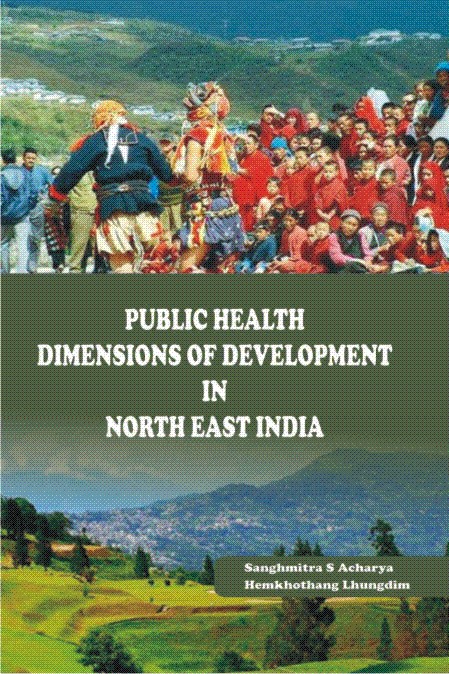
The present book maps development processes and their outcome in the Northeastern States of India. It initiates the discussion on the region to understand the historical manifestations of marginalization and exclusion of these states. Political disturbances, social identity, and infrastructure have posed concerns; while demographic performance, cultural plurality and rich biodiversity have been celebrated. The book addresses the politicohistorical context of regional development; socio demographic and economic change; reproductive health, lifestyle habits, youth, indigenous medicinal substances; and public health concerns. It opens with a lucid introduction to the states; subsequently steering towards the regional disparities which have become important in context of the present development process. The book presents an overview of the issues of regional development; exclusion and inclusion; changing sociodemographic and economic characteristics and the need to strengthen the ties between the region and the Centre and other parts of the country. Spatiotemporal changes experienced by the region over a period of time to reflect upon the development trends visavis educational attainment, health care, nutrition, morbidity, occupation and work; social diversity, regional and economic differentials are the strong points of the book. The issues of inclusion and development have been extensively dealt with through nutrition, ARSH; alcohol consumption and its consequences to outline the current issues of health and lifestyle concerns of the young people. The policy and programmes which address perspectives of the users and providers of the care, factors which enhance and hinder care utilization; care and counselling for youthall have been used to profile the young population, specially girls, and their issues. Some other concerns such as reproductive health substance use; media menstrual hygiene practices; prevalence exposure; and knowledge of HIV/AIDS among adults; policy environment which govern alcoholic and other intoxicating substance use in the region too have been eloquently discussed in the book, Considering the strategic location, HIV and AIDS undoubtedly become an important concern which necessarily needs to be seen beyond health. It widens to become a development issues and not remain a health, or at large a public health issues. Factors which ail the provisioning of health care such as personnel, medical education institution and staff; health care centre and staff; physical infrastructure; distance; quality of services. The biodiversity and the consequent abundance of the medicinal substance in the region; local knowledge; national and international trade of medicinal substances and their impact on local knowledge and those who possess it are issues which play crucial role in health care for a large part of the population living in developing countries. With recent revival of 'back to nature' concept, there has been an upsurge in the use of
Sanghmitra S Acharya is an Associate Professor at the Centre of Social Medicine and Community Health, School of Social Sciences, Jawaharlal Nehru University in New Delhi, India. She was an Adjunct Associate Professor in the Department of Sociology, Ball State University, Muncie, INDIANA, USA during 200809. As an ASF fellow during 2005 she was affiliated to the University of The Philippines Population Institute (UPPI), Manila for her research on young people. She attended summer workshop at EastWest Centre, Honolulu, Hawaii, USA (2003). She worked on gender issues during the UNFPA Global Training Programme on Population and Sustainable Development at the University of Botswana, Gabarone (Southern Africa) during 199596. More recently she travelled to China as part of India China Exchange programme of the ICSSR in December 2012 to further her research on conservancy workers. She received her doctoral degree from the Centre for the Study of Regional Development, School of Social Sciences, Jawaharlal Nehru University. Her recent work is on the issues of discrimination and exclusion. Hemkhothang Lhungdim is currently Associate Professor with Department of Public Health and Mortality Studies, International Institute for Population Sciences (IIPS), Mumbai. Dr. Lhungdim obtained MA (1984), M.Phil and PhD (1994) from the Centre for the Study of Regional Development, School of Social Sciences, Jawaharlal Nehru University, New Delhi. He works on the population and health issues. He has coordinated World Health Survey, India 2003, National Family Health Survey (NFHS3), Concurrent evaluation of NRHM (200910), and, the District Level Household and Facility Survey (DLHS4). Dr. Lhungdim has received training in demography at Cairo Demographic Centre, Egypt (2001), and attended summer courses at EastWest Centre, Honolulu, Hawaii, USA (2000), Centre for Population Studies, London School of Hygiene and Tropical Medicine (2004), and The Bill and Melinda Gates Institute for Population and Reproductive Health, Johns Hopkins Bloomberg School of Public Health, Baltimore, Maryland, USA (2005).
Acknowledgement Preface List of Tables List of Figures List of Plates List of Abbreviations List of Contributors Introduction: Knowing the North Eastern States An Overview SectionI: Regional Disparities 1. Population Dynamics and Development Patterns in North Eastern States A Geographical Analysis 2. Health of the Women in the North Eastern StatesExamining Issues with Special Reference to Meghalaya 3. Nutritional Disorder among Male Youth in North Eastern India: sociodemographic determinants, regional variation and implications 4. Children's Health Status in North East States of India SectionII: Inclusion and Development 5. ARSHHas it reached the Adolescent in Manipur? 6. Alcohol Consumption and Health Consequences A Study in Darjeeling Hills 7. Development, Health Care and Indigenous Medicine in Manipur SectionIII: Critical Issues 8. Indigenous Knowledge on Medicinal Substances and International Protocol Some Issues and Concerns in Manipur 9. High prevalence and knowledge of HIV/AIDS among adults in Manipur: do programmes fail to address the community, besides PLWHA? 10. HIV/AIDS Spread and Care mechanisms for PLWHA in Darjeeling: Historical Context and the Recent Scenario Index

$280.00