
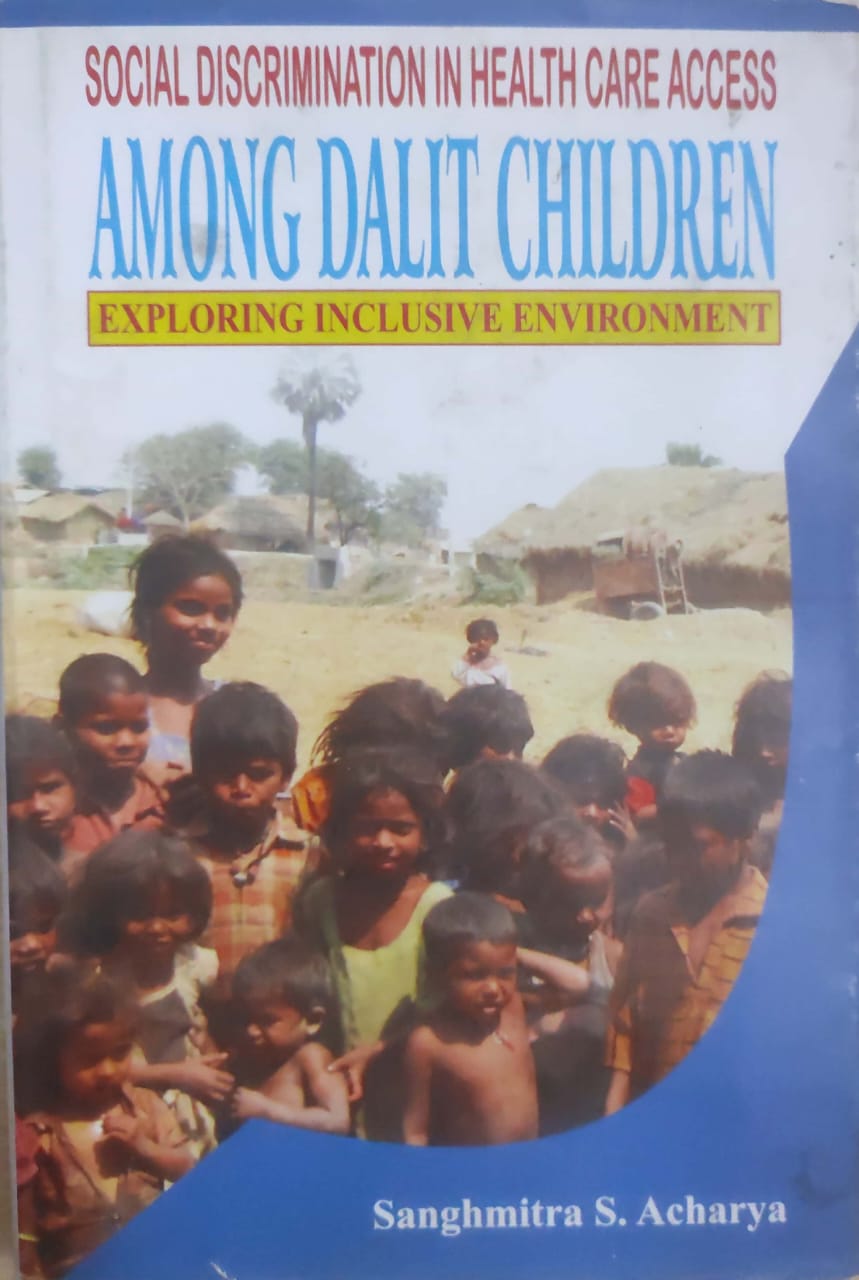
Social discrimination is a universal phenomenon which has existed over time and space. Caste, however, is a unique determinant of social discrimination in the Indian Sub continent Children in their vulnerability experience additional discrimination due to their age and social identity as Dalits. They experience social hindrances towards health care access and often have to travel longer than others for accessing service. Different forms of discriminations are manifested at the interface of various factors and hence experienced differently by Dalit children. The forms and spheres of discrimination experienced by dalits children in access to and utilization of health services are many which have been reflected in the present study. Availability and efficiency of the system is as important to Dalit children as to others in accessing any service. Dalit children share all other limitations in the system like others and shares some more faced by other marginalized sections like poverty. They face additional and complex forms of discrimination owing to their bottom rung placement in the caste system. Issues of institutional exclusion and discrimination where the policy, organizational structures and the service providers are not sensitive to the concerns of the Dalit children are of particular concern in this book. The thrust is on the experience of dalit children in accessing health care and the consequent social discrimination faced. These experiences have been used to understand the spheres and form of social discrimination and the personnel who practice social discrimination at different levels of health care provisioning. The study locates dalit children in the larger social frame to understand the factors which make them vulnerable and expose them to discrimination and exclusion. Factors which enhance and hamper their access to resources has been attempted to be studied in the light of the theoretical perspective of social identity and social capital. The study design includes field study conducted in the 12 villages of selected districts of Gujarat and Rajasthan to understand castebased discrimination in access to health services experienced by dalit children by examining the denial of access to health services; and forms of social discrimination. The book discusses the typology of discrimination and attempts to measure discrimination. The methodology used includes construction of index of discrimination; qualitative methods of data collection such as in depth interviews, exit interviews, consultative meetings and groups discussions using semi structured questionnaires; interview guides, checklist and field notes dairy. The study illustrates that the experiences of discrimination are varied in terms of form and spheres. Health care providers at higher hierarchy of health services are less discriminating as compare the grassroots level providers, both in public as well as private sector. Access to care among dalit children is better if the care pr
Sanghmitra S. Acharya is an Associate Professor at the Centre of Social Medicine and Community Health, School of Social Sciences, Jawaharlal Nehru University in New Delhi, India. She has also been at the Ball State University, Muncie, INDIANA, USA as Adjunct Associate Professor in the Department of Sociology during 200809. She was also awarded Asian Scholarship Foundation Fellowship during 2005. She was a Visiting Fellow at University of The Philippines Population Institute (UPPI), Manila, and studied health issues among the Filipino youth. She was a UNFPA Fellow for Global Training Programme on Population and Sustainable Development during 199596 at the University of Botswana, Gabarone (Southern Africa). She has also travelled to China, Thailand, Sri Lanka, Bangladesh and Germany. Her research interests include reproductive morbidity, gender, youth; urban health; and discrimination and social exclusion in health. She teaches courses on research methodology; population, health and development; urbanization and public health; and modules on demographic aspects of ethnicity and caste; social stratification; geographic mobility and migration; and social disparities in health.
Acknowledgements Foreword List of Table List of Charts List of figures List of Boxes 1. Health Care among Dalit Children Understanding Social Discrimination and Exclusion Introduction Understanding social discrimination Castebased Social Exclusion Caste based social exclusion in accessing health care Typology of discrimination in access to health care services by children Rationale for studying Discrimination among Dalit Children Conceptual Framework Understanding the Universe of the Dalit child Method of measuring discrimination Indicators for measurement of discrimination in various spheres 2. Understanding Social DiscriminationSome Theoretical Perspectives Social Capital Forms and Dimensions of Social Capital Types of Social Capital Advantages associated with Social Capital Social Identity 3. The StudyDesign and Conduct The Study Design Research Instruments Criteria for Selection of the respondent/participants Analytical Procedure The Study Villages 4. Dalits and Heath Care in Gujarat and Rajasthan Introduction Dalits: Some Reality Check Atrocities on Dalits Situation in Gujarat and Rajasthan Profile of Dalits in Gujarat and Rajasthan Understanding health services in Gujarat and Rajasthan Nutritional Status of People in Gujarat and Rajasthan Sociodemographic Profile of the study population People's Perception of Health Services System Issues in Accessing Health Care Services Caste discrimination in health sector 5. Discrimination Where, Why and by Whom? Experience of Discrimination Measuring Discrimination Degree of Discrimination Index of Discrimination Level of Discrimination Understanding Discrimination: Some Voices from the Field Finding from the discussions and Consultative meetings 6. Perception of Health and Access to Care among Dalits and Role of Civil Society and Capacity Building Initiatives Policy Suggestions 7. Summary and Conclusions References

$280.00